Nine Chapters Mathematical Art Rice Custom Station Problem 28 Chapter 6 Dou
The Ix Chapters on the Mathematical Fine art is widely acclaimed as "the supreme classical Chinese mathematical work" [Shen, v], "a kind of 'mathematical bible'" [Dauben 227, quoting Martzloff 127, who quotes Wang Ling's 1956 thesis xvi], the "near influential of all Chinese mathematical texts" [Swetz, viii], and "the nearly influential of all Chinese mathematical texts ... which occupies a like position in Chinese mathematics to that of Euclid'south Elements in Western mathematics" [Joseph 135]. Present-day versions of the Nine Chapters are based on one that was compiled past Zhang Cang and Geng Shouchang, most likely around 100 BCE, according to the preface of Liu Hui to his important commentary in the 3rd century CE. Shen'due south edition includes the commentaries past Liu and by Li Chunfeng and others (7th century). Shen [1] and Martzloff [134] list additional commentaries from the 5th, 6th, seventh, 13th, and 19th centuries.
The transliteration of the title of this piece of work (simplified Chinese: 九章算术; traditional Chinese: 九章算術; pinyin: Jiǔzhāng Suànshù [Wikipedia]) is variously given equally Chiu Chang Suan Shu [Swetz and Joseph], Jiuzhang Suanshu [Shen], and Jiu zhang suan shu [Dauben]; here it will be user-friendly, as in Shen, to simply call information technology the Nine Capacity. The publication of Shen's translation in 1999 has made this work readily available in the English-speaking world.
Joseph Dauben notes that the championship of the piece of work has been translated into English in a number of means in improver to the one given above. These include Arithmetic in Nine Sections; Computational Prescriptions in Nine Chapters; Nine Categories of Mathematical Methods; and The Ix Chapters on Mathematical Procedures [227]. The last of these is a translation itself from a 2004 French translation of the Nine Chapters past Karine Chemla and Guo Shuchun. We had the opportunity to meet and talk with Guo Shuchun at the Constitute for the History of Natural Sciences, role of the Chinese Academy of Science in Beijing.

Figure 3. Guo Shuchun displays his and Karine Chemla'south translation from Chinese into French of the Nine Chapters; behind him is Tina Straley, and so Executive Director of the MAA (photo by the author).
Unlike Euclid's Elements, the Nine Capacity is not organized every bit an axiomatic presentation of theorems and proofs; rather it is a collection of problems organized by topic and by the algorithms used for their solution. It is intended to be practical and pedagogical [Shen, vii] and was one of the works studied for official mathematics examinations for civil servants in the Tang Dynasty [Dauben 227].
The importance of the Nine Capacity is recognized among contemporary Chinese mathematicians and historians; Figures 4-six are photographs of presentations that nosotros saw in Prc that mentioned the Nine Chapters.

Figure iv. Dianzhou Zhang, of East Primal Normal University in Shanghai, shows a slide from a lecture, "Mathematical Exchange Between Communist china and the United States," which began with background on ancient Chinese mathematics (photo by the writer).

Figure 5. Guo Sharong of Inner Mongolia Normal University shows a slide from a lecture, "Some New Thoughts on Chinese Mathematics During the 13th and 14th Centuries – The Construction of Mathematical Models." Some problems in the piece of work of the 13th-century mathematician Li Ye, namely Yuan Cheng Tu Shi (Analogy of a Circle Town), tin be traced to the 9 Chapters (photograph past the author).
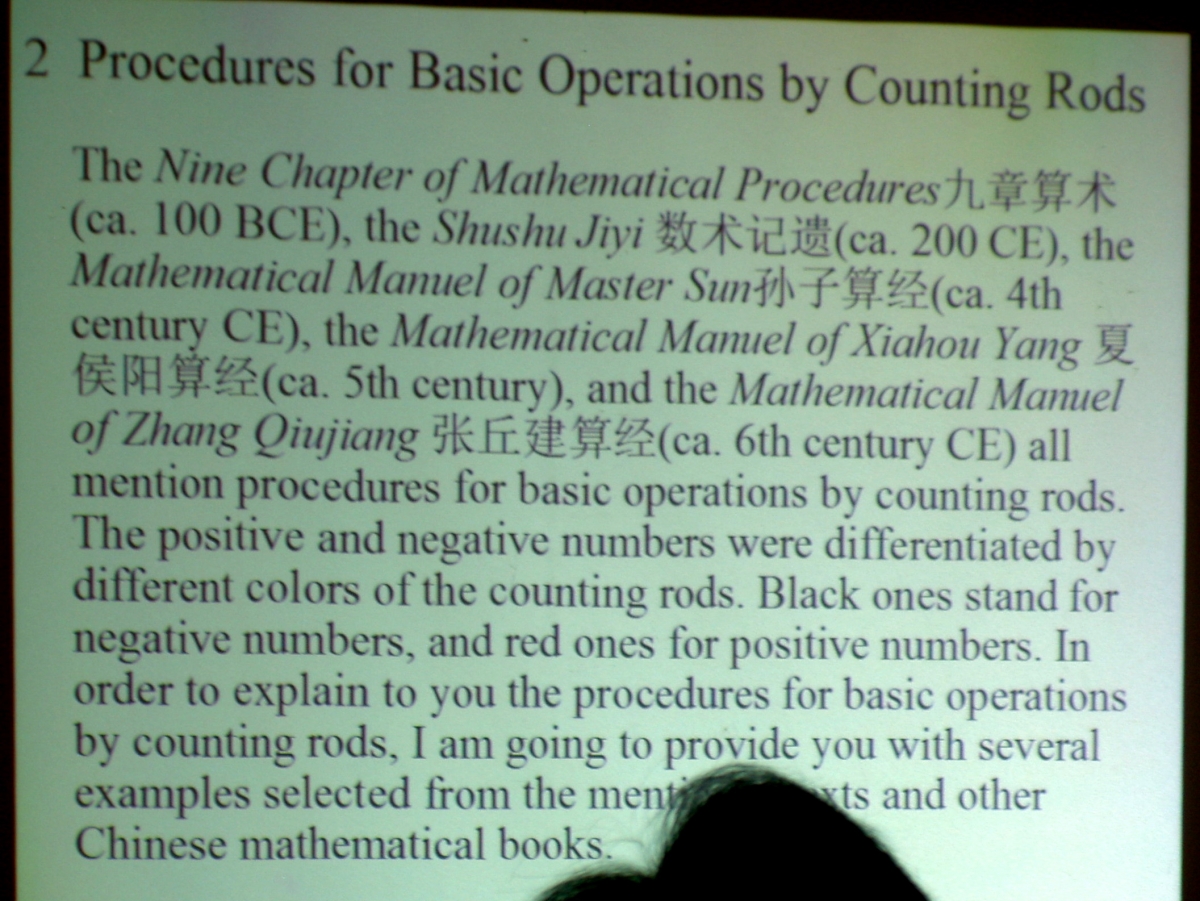
Effigy six. A lecture past Feng Lisheng of Tsinghua University, "From Counting Rods to Abacus: Traditional Chinese Counting Techniques," included a discussion of the utilise of counting rods to perform bones arithmetic operations in the Nine Chapters (photo by the writer).
Tabular array of Contents of The 9 Capacity on the Mathematical Art
Now, we plow to the mathematical content of the Nine Chapters. The titles of the nine chapters, with a cursory summary of the content of each, are equally follows [Haack]:
Chapter 1. Field Measurement. This affiliate includes problems to notice the areas of rectangles, triangles, trapezoids, circles, and related regions. Arithmetics techniques are adult to carry out computations with fractional quantities.
Affiliate two. Millet and Rice. This chapter includes problems of proportions and unit prices. The Rule of Three (similar to cantankerous multiplication) for solving proportions is seen as an extension of the work with fractions in the outset affiliate.
Chapter 3. Distribution by Proportion. This chapter extends the problems solved via proportion in the previous chapter.
Affiliate 4. Brusque Width. This chapter seeks the side or diameter of a region from known areas and volumes. Arithmetic results developed include algorithms to extract square roots and cube roots by hand.
Chapter 5. Structure Consultations. This chapter seeks the volumes of a number of solids that occur in construction problems. Formulas for the solution of such bug are developed, ofttimes in several unlike ways.
Affiliate 6. Fair Levies. Farther extensions of the proportion bug of Chapters 2 and iii are developed here. At that place is also a consideration of the sums of arithmetic progressions. The kinds of discussion problems that appear include piece of work problems and distance and charge per unit problems.
Chapter seven. Excess and Deficit. The affiliate title refers to a technique to solve two linear equations in two unknowns [double false position]. Again, a multifariousness of word problems are solved using this technique.
Chapter 8. Rectangular Arrays. Issues of agricultural yields, the sale of animals, and a variety of other problems, all leading to systems of linear equations, are solved by a method that is known in the W as Gaussian elimination. The problems lead to systems ranging from 2 equations in ii unknowns to six equations in 6 unknowns, and one problem leads to an indeterminate arrangement of v equations in six unknowns.
Affiliate 9. Right-angled Triangles. Problems in surveying and in the lengths of various line segments are solved using the Gougu Rule, the Chinese version of the theorem known in the West as the Pythagorean Theorem. The problems demonstrate familiarity with Pythagorean triples.
Source: https://www.maa.org/book/export/html/863323
0 Response to "Nine Chapters Mathematical Art Rice Custom Station Problem 28 Chapter 6 Dou"
Post a Comment