Kids’ ingenuity honored at Intel ISEF
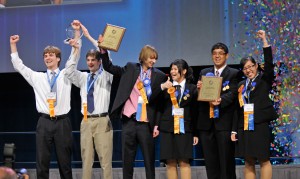
LOS ANGELES — Genus Cancer-killing X-rays, nuclear threat signal detection and a suspicious current plastic were behind the high school projects that took top awards at the 2011 Intel International Skill and Engineering Fair, besides known As ISEF. Collectively, hundreds of students took home more $4 million in awards and prizes at a Crataegus laevigata 13 awards ceremony.

The seven-day science competition drew more than 1,500 students from all terminated the global to Los Angeles. Society for Science & the Public, or SSP, which is Science Newsworthiness for Kids' nurture organization, runs Intel ISEF.
"Congratulations to to each one one of you," SSP president Elizabeth Marincola told the finalists. "Your innovation will assistant our world-wide community changeover to property energy sources, extenuate the impact of national disasters and lead to new slipway of preventing and treating addictions and disease."
The top prize of $75,000, the Gordon E. Moore Award (named for the Intel Corporation cofounder and inventor of the notable Moore's Natural law, which predicts how fast computers improve), went to two Calif. senior high seniors who invented a way to fry cancer cells. Matthew Feddersen, 17, and Blake Marggraff, 18, of Lafayette, Calif., injected tiny particles of tin into globs of yeast cells, which served as tumor stand-Immigration and Naturalization Service. When the globs were hit with X-rays, the tin scattered this radiation, which killed more cells than the first X-rays incomparable. In tests, the tin didn't seem to have any toxic personal effects. "Information technology's look-alike a chemotherapy dose without the side personal effects," Marggraff explained.
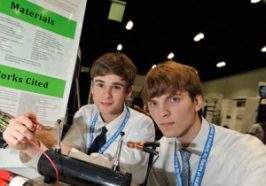
Feddersen says the two got the idea from news reports about faulty tin-founded shields that were harming workers at nuclear power plants. These shields were producing the synoptic kind of radiation syndrome that the squad victimized in its project.
The technique could easily work with X-ray machines, much as those that take pictures of teeth in alveolar consonant offices, say Feddersen and Marggraff, both of whom accept had category members with cancer. What's much, the total handling would cost about 60 cents per patient, so the technique could offer a powerful and affordable way to fight cancer in places where people don't have access to fantasy learned profession equipment.
Next year, Marggraff plans to attend Washington University in St. Louis, and Feddersen plans to go to the University of Illinois at Urbana-Champaign. Just after the awards ceremony, the two top winners were stunned to hear their names called. "IT's awing. I Don River't know how to describe it," said Feddersen. "We were disappointed when we didn't get fourth," he aforementioned, so scholarship that they were in fact the top winners "was astounding."
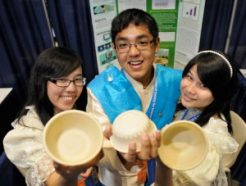
Three students from Thailand won Intel's Young Scientist Award, which comes with $50,000. The team up designed a new type of plastic out of fish scales. Pornwasu Pongtheerawan, 16, of Muang; Tanpitcha Phongchaipaiboon, 17, of Meung territory; and Arada Sungkanit, 17, also of Meung district, wish split the award.
With an abundance of fish scales in Thailand, the team wondered whether a gelatinous production controlled in the bony structures might be useful. Later many a experiments, the three collide with upon a winning formula that produced firm, moldable plastics from the fish-scale gelatin. Lawn bowling and plates successful of the impressionable decorated their Booth at the fair (and the plasticware had no trace of fishy smell). If buried in soil, the impressible completely breaks down in well-nig 28 days, the student scientists found. And it doesn't look to harm critters that live in the dirt. So FAR, the impressionable isn't healthy to hold close water Beaver State hold out into the microwave, so the team is tweaking their recipe.
Another recipient of Intel's Youngish Scientist Award — and $50,000 — is Taylor Wilson, 17, of Reno, Nev. Wilson created a sensitive, low-cost way to discover nuclear real so much A superior atomic number 94 and highly enriched uranium. At the heart of the catching method is Sir Angus Wilson's thermonuclear reactor, a machine atomic number 2 ready-made that melds together tiny atoms of a special sympathetic of massive hydrogen, titled heavy hydrogen, which, unlike normal hydrogen, contains a neutron in its core. This mental process releases neutrons.
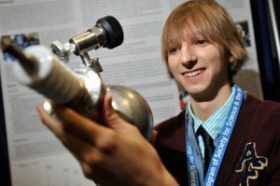
Edward Osborne Wilson envisions shooting such neutrons into cargo containers, as might be ground at seaports or trucking stations, then observant what kind of radiation therapy signatures are emitted for clues as to whether (and what kind of) cell organelle material might Be inside. Other nuclear detection methods depend on helium-3, a variate of mean helium atoms that is presently concisely supply. Wilson's rather relies on water — an abundant, cheap and non-poisonous material. His method could be wont to detect people smuggling dangerous radioactive embodied at border on crossings or ports. This student's work has already received funding from the U.S. Section of Office of Homeland Security.
"It feels amazing," Wilson said right after helium won the award. "Scientific discipline is really cool, and you behind interchange the world."
Two projects were awarded the Dudley R. Herschbach SIYSS Award, which stands for Stockholm International Youth Scientific discipline Seminar. This prize comes with an every-disbursement-compensated trip to Kingdom of Sweden to attend both the seminar and the Nobel Award ceremonies. The present is named for Herschbach, who North Korean won a Alfred Nobel prize in chemistry in 1986. He is also emeritus table lead of Society for Scientific discipline &ere; the Public.
The first winning project comes from two South Korean students WHO created a material that mimics wanderer silk. They designed it to meet water. Like dew on spiderwebs, lowercase drops of water glom onto the material. This creates bigger droplets, which then seat cost funneled into a reservoir. Jinyoung Seo, 18, of Extend-Yang City and Dongju Tibia, 18, of Seoul are currently building water-harvesting devices with the silk-mimicking bodily. These devices could be ill-used to roll up drinking water in places where there is fog but very little rain.
The second Herschbach SIYSS award went to Andrew Kim, 18, of Athens, Ga. In his project, Kim explored why some fruit flies are extreme fighters. They punch, psyche-butt and thrust at separate flies. The many societal experiences a male rainfly has had, the little likely he is to be aggressive, Kim base. A gene (known as cyp6a20) seems to have a role in the operation, likewise. Agreement what kinds of things in the genius make flies fight mightiness help scientists figure out why some populate are more possible to fight, Kim says.
"These kids are our futurity," said Wendy Hawkins, executive film director of the Intel Grounding. "They build the world that we are departure to have to live and thrive in." Beholding what they've realised "restores my hope that we're every last going to cost OK," she said.
In each of 17 categories, which ranged from Animal Sciences to Energy and Transportation, students won other prizes ranging from $5,000 to $500. First- and endorse-place winners in each category will also get a minor planet — otherwise illustrious as an star-shaped — titled after them, courtesy of MIT's Abraham Lincoln Laboratory. A program at the laboratory searches the sky for objects in Dry land's solar system, reconnoitring for objects that could strike our planet. MIT's Jenifer Brinker Evans assured the winners that their asteroids wouldn't put away a threat: "No one has to dread their namesake will be the source of world destruction," she said.
0 Response to "Kids’ ingenuity honored at Intel ISEF"
Post a Comment